Helen

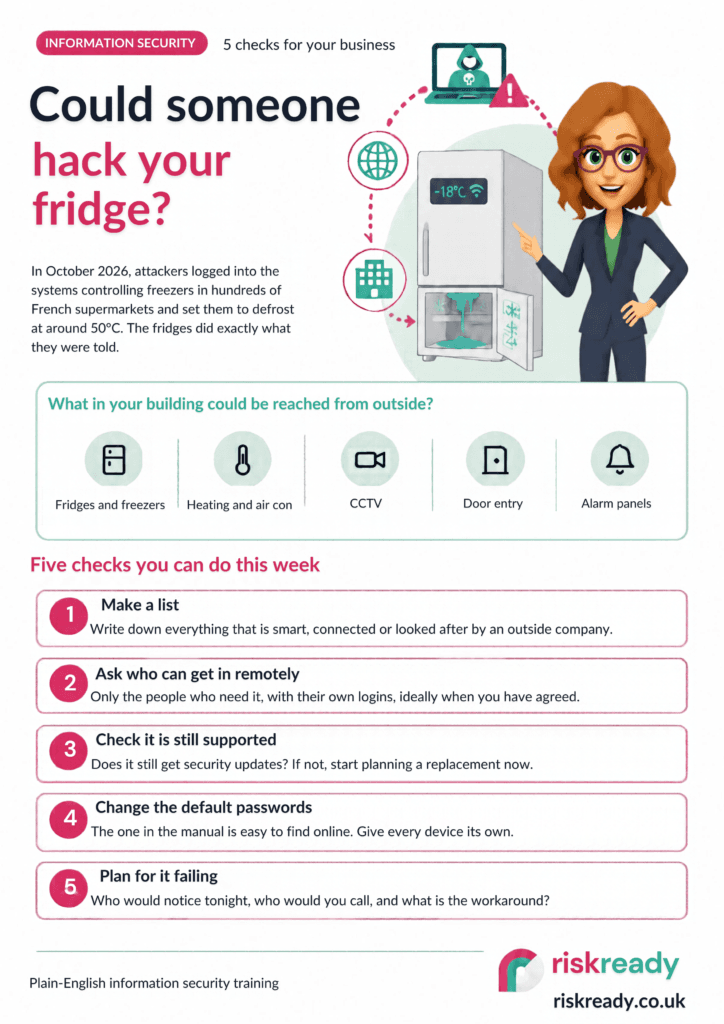
Infographic showing water needs scaling from 3 litres per person to 36 litres for a family of four

Does the Government’s Emergency Kit Checklist Actually Work for Your Home?

You may have seen the government’s new Be Ready campaign asking every household to be ready to manage for three days in an emergency — a power cut, flooding, whatever it turns out to be. Good idea, in principle. But if you actually try to follow the checklist as written, a couple of the numbers

Does the Government’s Emergency Kit Checklist Actually Work for Your Home? Read More »

Illustrated woman looking reassured at a laptop showing a website security check has passed

What Is PHP2Shell, and Does My Business Need to Worry?

If you’ve seen headlines this week about a “critical flaw affecting 70% of the internet” and felt your stomach drop slightly, take a breath. Here’s what’s actually going on, in plain English, and four things worth checking today. What actually happened Most websites — including an awful lot that small and medium-sized businesses use without

What Is PHP2Shell, and Does My Business Need to Worry? Read More »

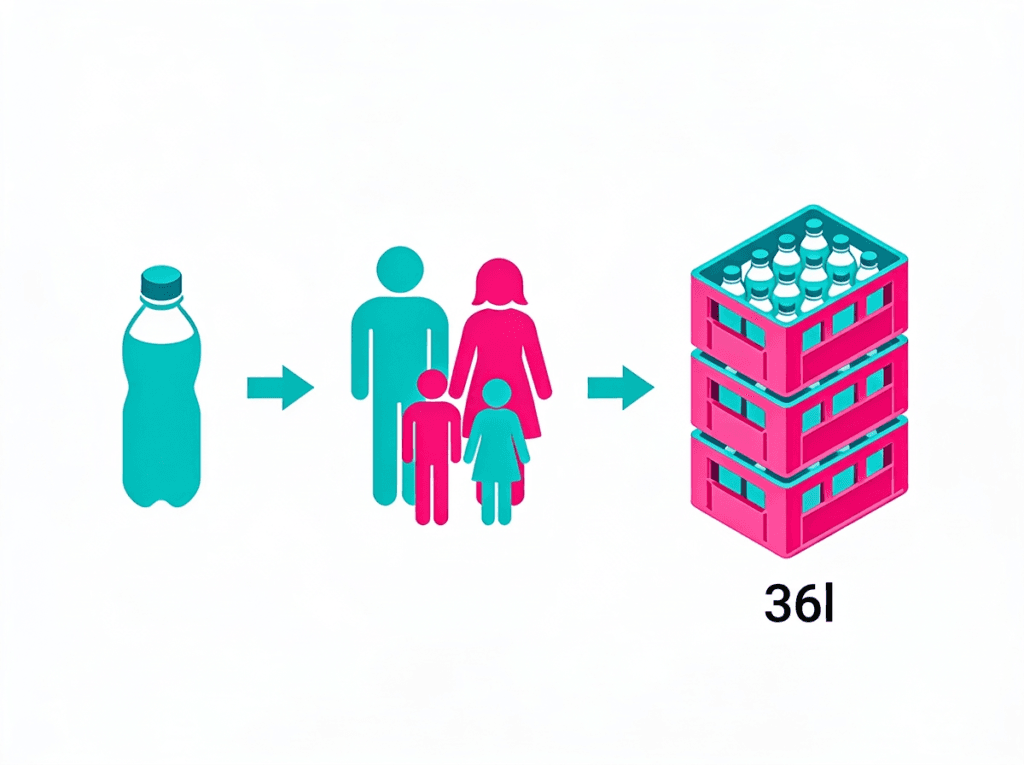
An infographic from RiskReady asking “Could someone hack your fridge?”. It explains that attackers set supermarket freezers in France to defrost, shows everyday connected devices such as fridges, heating, CCTV, door entry and alarm panels, and lists five checks: make a list, ask who can get in remotely, check it is still supported, change the default passwords, and plan for it failing.

Could someone hack your fridge? What the French supermarket attack means for your business

On Sunday night, staff at hundreds of French supermarkets arrived at work to find the freezers warm, the food spoiled and, in a few stores, equipment that had overheated so badly it had started to burn. Nobody had broken in. The attackers had logged into the systems that control the fridges and told them to

Could someone hack your fridge? What the French supermarket attack means for your business Read More »

Clay illustration of a small tanker passing a lighthouse at dusk, illustrating risk appetite vs risk tolerance

Risk Appetite vs Risk Tolerance: What’s the Difference?

If you’ve ever sat in a meeting where someone talked about risk appetite and someone else talked about risk tolerance, and you quietly wondered whether they meant the same thing, you’re in good company. They are two of the most muddled terms in risk management, and I regularly see them used interchangeably in policies and

Risk Appetite vs Risk Tolerance: What’s the Difference? Read More »

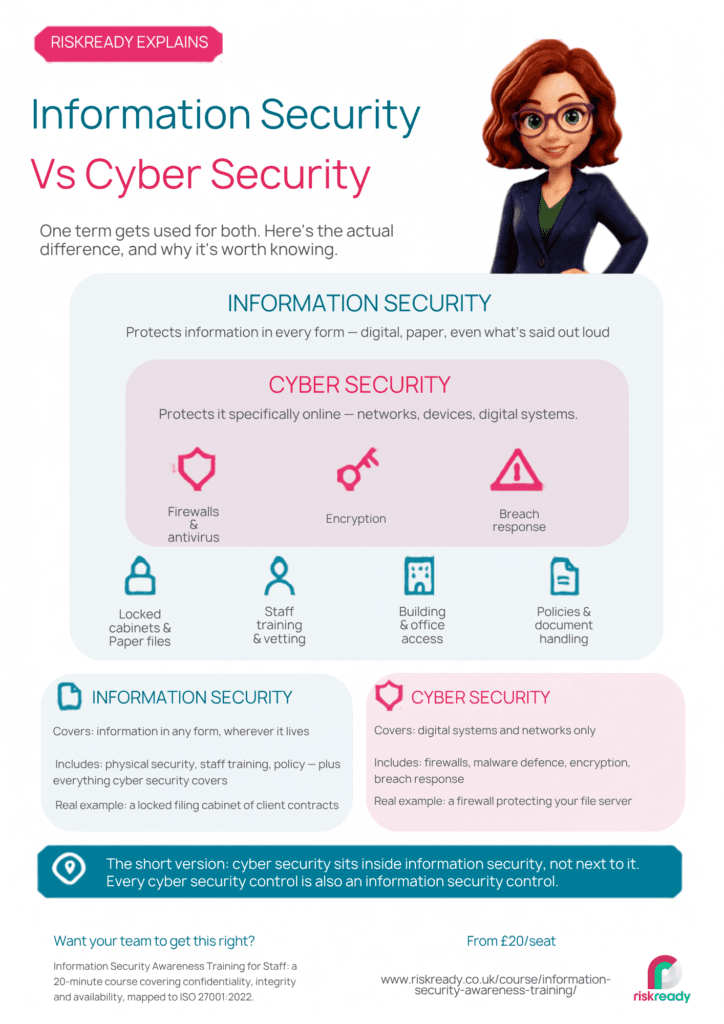
Infographic explaining the difference between information security and cyber security. Information security covers protecting information in any form — digital, paper, even spoken — while cyber security is the narrower part of that covering only digital systems and networks. Includes examples: a locked filing cabinet (information security) versus a firewall (cyber security).

Information security vs cyber security: are they actually the same thing?

Short answer: no. Slightly longer answer: no, and the difference is worth five minutes of your time, because getting it wrong in a tender response or a job description is one of those small mistakes that quietly tells a reader you haven’t quite done your homework. We hear the two terms swapped constantly — in

Information security vs cyber security: are they actually the same thing? Read More »

Illustrated woman getting a failed-email error on her laptop, holding up her phone to a team group chat instead

What Happens When Your Email Goes Down (And How to Make Sure You Can Still Talk to Your Team)

This week, Outlook and email hosted through Microsoft went down for hours, for a huge number of people, all over the world. If you tried to send an email on Monday and it just sat there, or you couldn’t log in at all, that wasn’t your computer. That was everyone. The cause turned out to

What Happens When Your Email Goes Down (And How to Make Sure You Can Still Talk to Your Team) Read More »

Illustrated woman sitting at a laptop with a thoughtful expression, considering what to do after receiving a data breach notification email.

Got a Data Breach Email? Here’s What to Actually Do

If you’ve had an email recently telling you your data was caught up in a “cyber security incident”, Manchester Airport’s recent breach notification will be a familiar shape to a lot of people right now. The natural reaction is to read it once, feel briefly uneasy, and then do nothing with it. That’s understandable. Most

Got a Data Breach Email? Here’s What to Actually Do Read More »

3D clay illustration of a stamp marked "aligned" next to a figure handwriting in a notebook, representing the gap between standards alignment and practical loggist training

What “Aligned to the National Standards” Actually Tells You

I’ve spent a chunk of this week reading National Occupational Standards, which is not a sentence I expected to type. It started because I wanted to check how our own loggist training holds up against the Resilience and Emergencies NOS — the official competency framework for this sector. Sensible enough. Then I noticed that the

What “Aligned to the National Standards” Actually Tells You Read More »

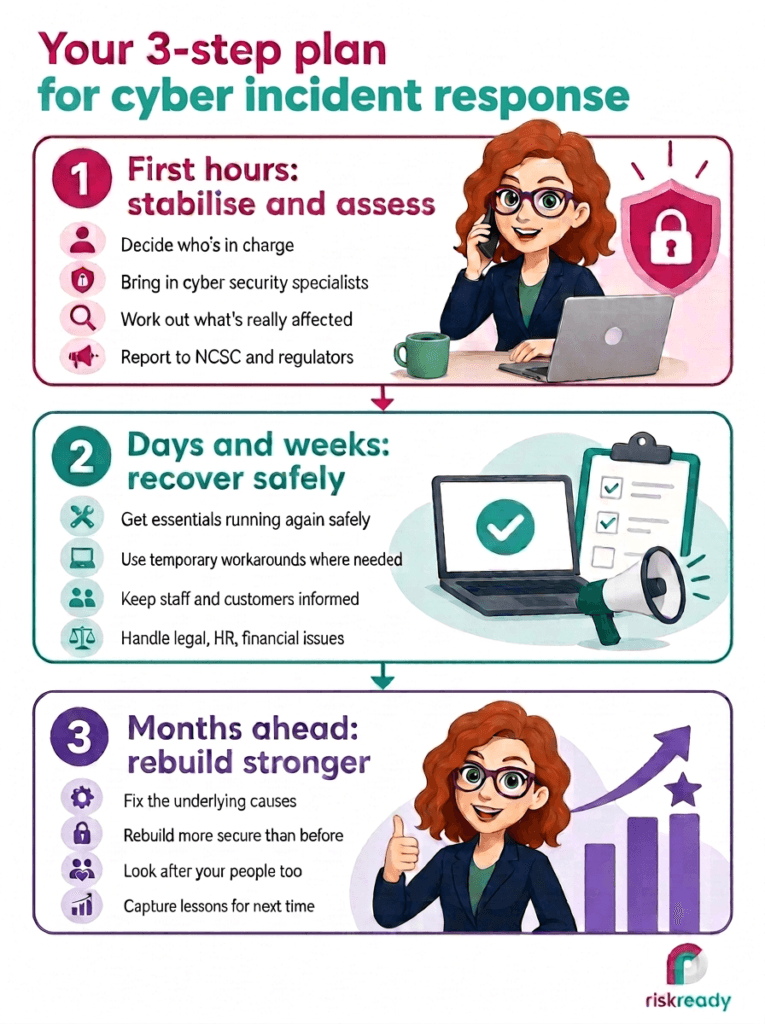
Infographic showing a 3-step plan for cyber incident response: first hours to stabilise and assess by deciding who's in charge, bringing in specialists, and reporting to the NCSC; days and weeks to recover safely by restoring essentials, using workarounds, and keeping people informed; and months ahead to rebuild stronger by fixing root causes and capturing lessons learned.

What to do when a cyber attack hits your business (in plain English)

The National Cyber Security Centre published new guidance in late July on recovering from a disruptive cyber attack. It’s genuinely good advice, but it’s written for organisations with a CISO, a Board and a dedicated IT team. If you run a smaller business, some of it won’t map onto your world at all. Here’s what

What to do when a cyber attack hits your business (in plain English) Read More »