
The loggist: one of the most important roles nobody trains for
If you’ve ever sat in an incident management team meeting, you’ll know how quickly things move. Decisions get made, actions get assigned, phones ring, people talk over each other. And somewhere in the middle of all of that, someone is supposed to be keeping an accurate record of everything that happens.
That someone is the loggist. And in my experience, it’s one of the most undervalued roles in the whole incident response structure.
So we made you something useful
We’ve put together a free infographic — The Loggist: Role at a Glance — that you can download, print, and tuck into your incident management plan. It covers the essentials: what a loggist actually is, the five things you should be recording, what your log sheet columns should look like, and (my personal favourite) a clear list of tasks that are absolutely not your job.
And no, you are not there to make the tea!
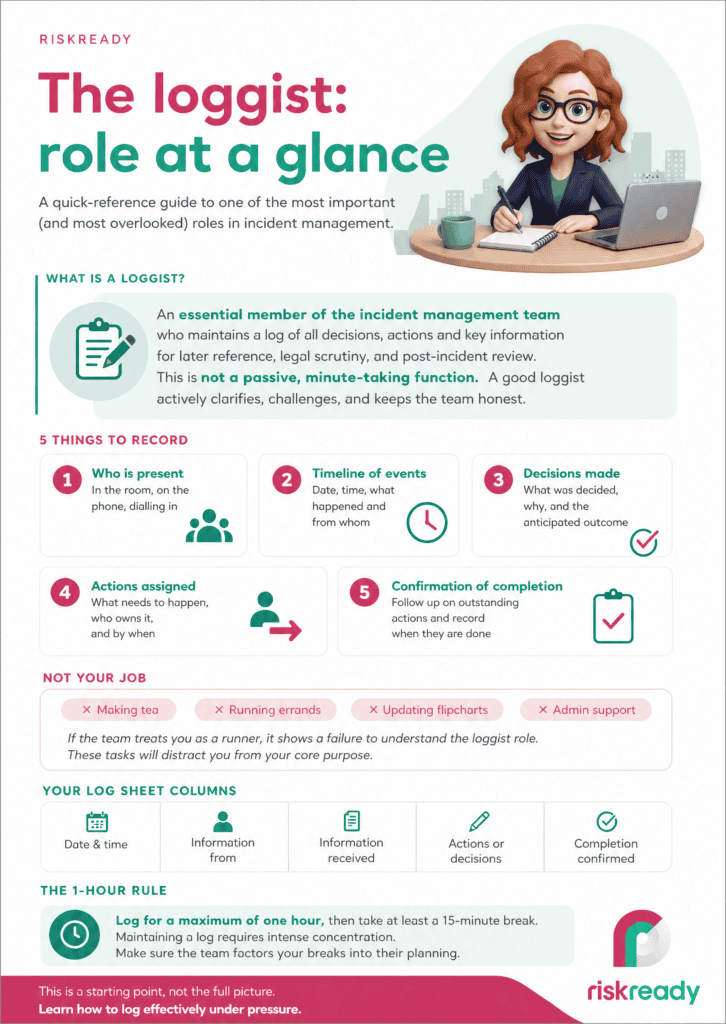
It’s designed to be a genuine quick-reference tool. Something you could hand to a colleague who’s just been told they’re logging for the first time, or pin up in whatever room you use for incident response.
Here's the thing, though
Knowing what to record and knowing how to do it well under pressure are very different things.
The infographic will tell you that you need to capture decisions and their rationale. What it can’t teach you is how to keep up when three people are talking at once and the chair has just changed direction mid-sentence. It’ll tell you that you should seek clarification when something is unclear, but it won’t walk you through how to do that confidently without derailing the meeting.
There’s also the legal side. Your log could end up as a discoverable document in legal proceedings or a public inquiry. That changes what you write and how you write it. Factual, not critical. No speculation, no assumptions, no changes after the event. The infographic touches on this, but understanding the implications takes a bit more than a one-liner..
And then there’s the practical stuff that only comes with practice: when to push back, how to manage shift handovers, whether to use a paper log or go electronic, and how to pace yourself when concentration starts to fade (the one-hour rule exists for a reason).
Want to go further?
Our Loggist Training course covers all of this in detail. It’s built around real scenarios, with an exercise you can submit for feedback, and you’ll get a certificate of completion at the end.
It’s designed so you can work through it at your own pace, and it’s ideal for anyone who might be asked to pick up a pen (or open a laptop) the next time something goes wrong.
Related posts:
 New Year, New Loggists: Why Now Is the Perfect Time to Build Your Log‑Keeping Capability
 RiskReady Shortlisted for Specialist Company of the Year at the Business Continuity Awards 2026
 How One Local Authority Transformed Loggist Training with a Cost-Effective 3-Year Licence
 Behind the Scenes: Designing RiskReady’s Learning Experience